I would not risk the risk free 4 per cent
Sumit Tiwari · Certified Estate Planner (EPPL) · August 2026 · 4 minute read
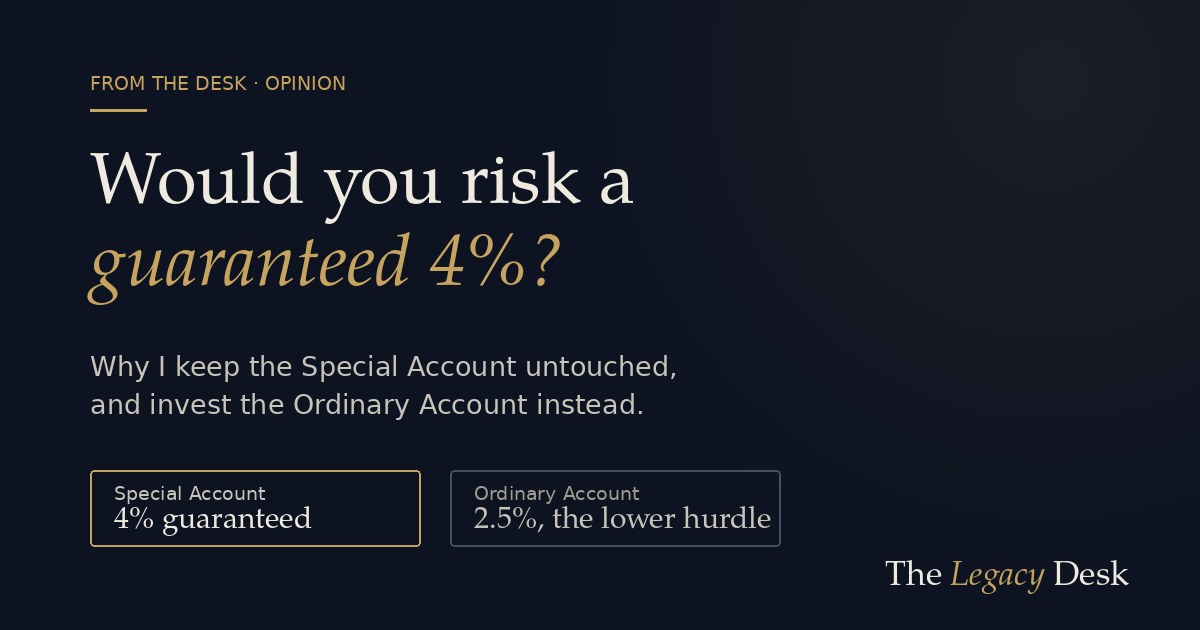
The Business Times recently ran a podcast with a provocative title: risk, or not risk, your risk free 4 per cent CPF return. It is a fair question, and one that clients ask me in different words almost every month. Should I invest my Special Account savings, or leave them alone?
My stand is simple. Do not risk it. Keep the Special Account untouched, and if you want to put CPF money to work in the markets, invest from the Ordinary Account instead.
The rarest asset in Singapore finance
Think carefully about what the Special Account actually is. It is money that compounds at around 4 per cent a year, guaranteed by one of the few remaining triple A rated governments in the world. It does not fall when markets fall. It charges no management fee, no platform fee, no sales charge. It cannot be surrendered in a panic, mistimed, or churned.
If a private banker offered you a product with those exact features, you would ask what the catch is. There is no catch. You already own it.
Nobody sells you the Special Account, and that is precisely why it is underrated. There is no commission in telling you to leave something alone.
The hurdle is higher than it looks
To justify moving Special Account money into an investment, that investment must beat 4 per cent a year, after fees, with enough margin to compensate you for the risk you took. A typical unit trust in Singapore might charge 1 to 1.5 per cent a year once all costs are counted. That means your fund must earn roughly 5.5 per cent, every year, on average, just to match what the guarantee gave you for free.
Markets can certainly deliver that over long periods. But they deliver it with drawdowns of 30 to 50 per cent along the way, and they do not check your age before a crash arrives. A guaranteed 4 per cent compounding quietly through a crisis is worth far more than the spreadsheet suggests, because it is the money that lets you leave your other investments alone when everything is red.
Put $100,000 in the Special Account at 4 per cent and in twenty years it becomes roughly $219,000, with certainty. The alternative might become more. It might also become much less, at exactly the moment you need it to be there.
If you want to invest CPF, the Ordinary Account is the right pocket
The Ordinary Account earns 2.5 per cent. That is a much lower hurdle. A globally diversified, low cost portfolio held for fifteen or twenty years has a reasonable prospect of beating 2.5 per cent, and the gap between what you give up and what you might gain is wide enough to be worth the risk for money you will not need soon.
So the order of operations, in my view, is this:
- Leave the Special Account alone. It is your floor, and floors are not for gambling.
- If you have a long horizon and money in the Ordinary Account beyond your housing and near term needs, that is the pocket to consider investing, in diversified, low cost instruments, never in concentrated bets.
- Take your real risk outside CPF, with cash you can hold through a full market cycle.
This is also why I am wary of any adviser whose first suggestion is to move your Special Account into an investment product. The maths rarely favours you, but it always favours somebody.
The floor is the plan
Readers of this desk will remember the retiree who lost everything to a business partner he trusted. What broke him was not a bad investment. It was the dismantling of his floor. The Special Account is the one floor Singapore builds for you by default, and it pairs with the rest of your planning: a CPF nomination so the money reaches your family directly, a will for everything else, and an LPA so someone you trust can act if you cannot.
Grow wealth by all means. But grow it on top of the guarantee, not instead of it.
This is an opinion piece reflecting my general views as at August 2026, prompted by the Business Times podcast "Risk or not risk your risk-free 4% CPF return". CPF interest rates are reviewed periodically, floor rates and account rules can change, and figures above are simplified illustrations, not projections. Whether investing CPF savings suits you depends on your age, balances, housing plans and circumstances, so please check the CPF Board's official website for current rates and rules, and seek professional advice for your own situation.
Is your floor actually in place?
Our complimentary three minute readiness check looks at your will, CPF nomination, LPA and more, and shows you the gaps.
Take the readiness check